Researching East Asia Beyond Assumptions.
Comparative inquiry and interpretive analysis shaping new perspectives on regional politics.
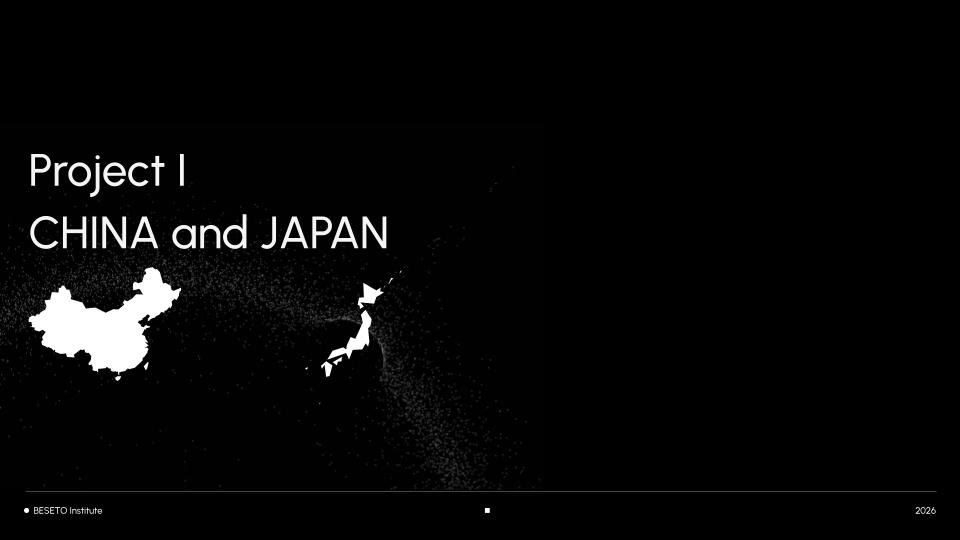
China and Japan : Beyond Difference, Parallel Trajectories
This project undertakes a structural and comparative examination of China and Japan that shifts the analytical focus from difference and rivalry to convergence and parallel development. Rather than approaching the two countries primarily as contrasting cases, it investigates how shared historical pressures, institutional constraints, and societal conditions are differently articulated yet frequently result in comparable patterns of governance, public discourse, and external behavior.
By tracing these parallel trajectories across politics, economy, society, culture, and historical experience, the project challenges entrenched assumptions that treat divergence as the default lens of comparison. It is conceived as a cumulative research endeavor, with selected essays published in leading international outlets and the project ultimately developed into a book-length work.

The Eastern Hemisphere : Shifts and Challenges
This project offers interpretive and forward-looking readings of contemporary East Asian international dynamics as they unfold in real time. Rather than seeking structural symmetry or comparative equivalence, it engages with emerging regional phenomena—strategic realignments, normative tensions, and shifting centers of influence—through bold analysis and creative interpretation.
Grounded in close observation of political discourse and regional developments, the project aims to reframe how ongoing changes are understood, questioning inherited assumptions and proposing alternative ways of conceptualizing East Asia’s role in global politics. Individual essays are developed for publication in international media and policy-oriented venues, with the project also envisioned as a future book.
✒️ Research Orientation
This research program examines contemporary East Asian international politics through two complementary but analytically distinct approaches. Rather than advancing a single explanatory model, it combines structural comparison with interpretive intervention to capture both enduring patterns and emerging transformations across the region. The program is grounded in the view that East Asia is not merely responding to global change, but actively generating new political logics, strategic behaviors, and normative tensions.
✒️ What Distinguishes This Research Program
Unlike conventional area studies that privilege either contrast-driven comparison or policy prescription, this program deliberately differentiates its analytical mode according to the nature of each research question. Some projects investigate shared structural conditions and parallel trajectories across societies, while others offer bold and creative interpretations of unfolding regional phenomena. This dual structure allows the research to remain analytically rigorous while maintaining intellectual flexibility and real-time relevance.
✒️ Analytical Approach
Methodologically, the program integrates comparative analysis, historical contextualization, and interpretive reasoning. Structural comparison is employed where convergence warrants systematic examination, while interpretive analysis is applied to rapidly evolving regional dynamics that demand conceptual innovation. This approach enables the research to move between long-term inquiry and timely analytical intervention, producing insights that are both durable and responsive to change.
© BESETO Institute. All rights reserved.
For research collaboration and media inquiries : contact@ibeseto.com